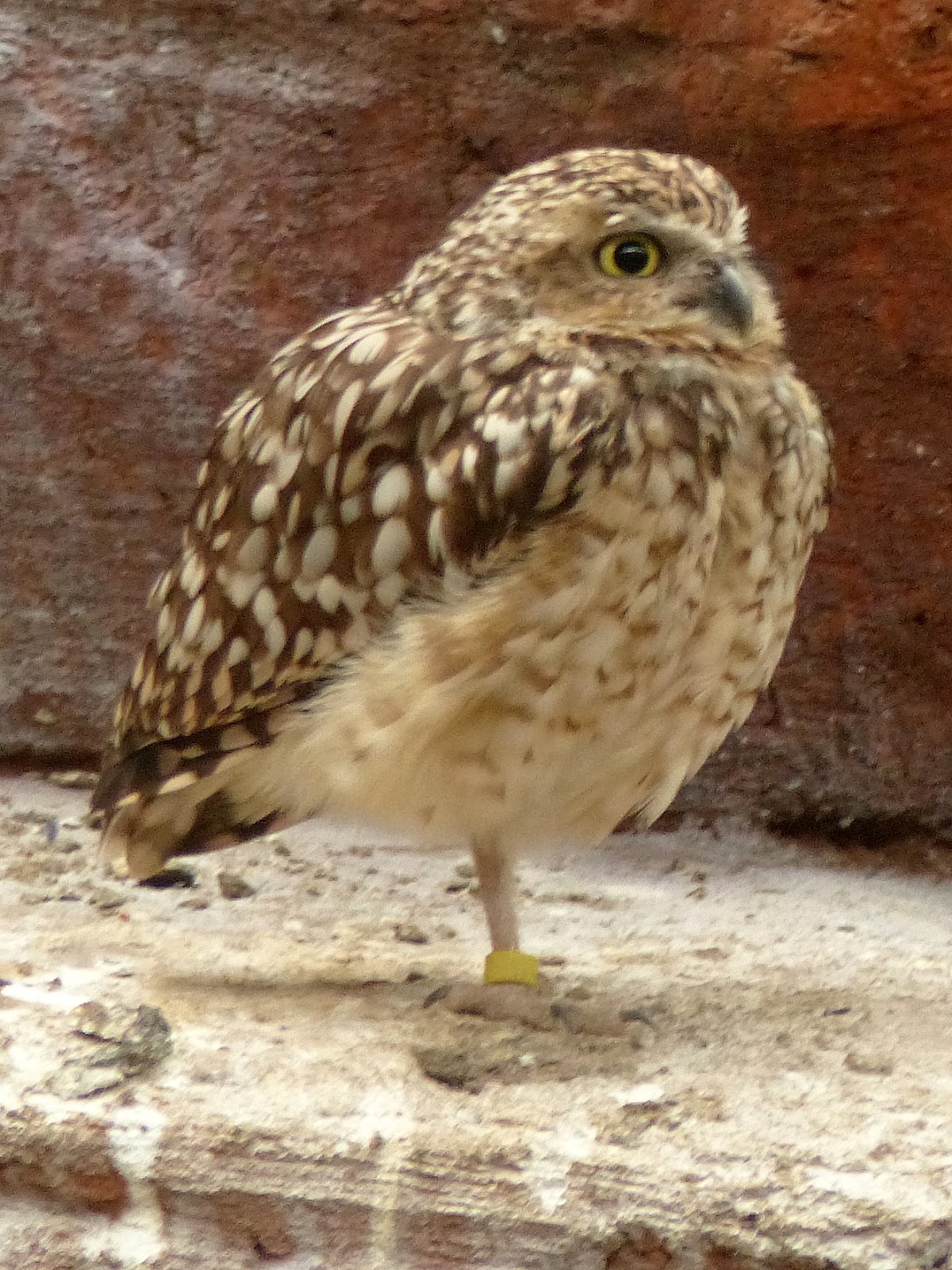
I called into Castle Espie WWT some time ago and Karl Hamilton from Mantella Evironmental Education CLICK HERE was showing people the Spectacled Owl. Pulsatrix perspicillata, a large
tropical Owl. It is a resident breeder from southern Mexico and Trinidad,
through Central America, south to southern Brazil, Paraguay and northwestern
Argentina. There are six subspecies. This Owl below is called Ralph and is 6 years old.
The Spectacled Owl can range from 17 to 20 in in
length. Mass in males can range from 0.999 to 1.543 lb, where as females can
weigh from 1.50 to 2.20 lb. It is
unmistakable with brown upperparts, head and upper breast, white facial
markings and whitish to yellowish-ochre underparts. The eyes are yellow and the
beak is pale.
The juvenile is even more distinctive than the adult, being completely white apart from a chocolate brown facial disc. Of the six subspecies, only the nominate and P. p. saturata are well described. P. p. saturata differs from the typical Spectacled Owl only in that it is black on the head and the back, with black barring on the sides.
The primary sound made by the Spectacled Owl consists
of knocking or tapping sounds with a popping effect: PUP-pup-pup-pup-po or BOO
Boo boo boo boo. Each progressive note becomes weaker but faster as the call
continues. Females also make a hawk-like scream, ker-WHEEER, which has often
been compared to a steam-whistle.
The Spectacled Owl is primarily a bird of tropical rain
forests, being found mostly in areas where dense, old-growth forest is profuse.
However, it may enter secondary habitats, such as forest edges, especially
while hunting. On occasion, they have been found in dry forests, treed savanna plains,
plantations and semi-open areas with trees.
This species is largely nocturnal, starting activity
right around the time of last light at dusk and usually being back on their
roosts for the day around first light. It is a solitary, unsocial bird, usually
roosting singly each day and only peaceable associating with others of their
own species for reproductive purposes.

The Spectacled Owl is typical the largest and most
dominant owl in its range, with the larger Great Horned Owl rarely venturing
into true rainforest habitats. Most hunting starts with the owl perched on a
branch and scanning the area, then dropping with a quick pounce when prey is
located. It preys principally on a wide array of mammals, eating almost
anything type that is nocturnally active. Various rodents may be primary but
other mammals preyed on have included opossums and skunks. Prey species can be heavier than the predating
owl, weigh over 3.3 lb as in Didelphis opossums, and even the much larger
three-toed sloth has been reported to have been killed. Invertebrates are eaten regularly as well,
mainly caterpillars, but also crabs, snails, large insects and spiders. Insects
may be gleaned directly from foliage while the large owls actively forage.
Birds are also taken, including species, such as jays and pigeons, which are
taken off of their nocturnal perches and smaller types of owl.

In Costa Rica, eggs are laid variously in the dry
season (November–May), or at the start of the wet season (June–July). This owl
typically nests in an unlined tree cavity. Spectacled Owls lay 1-2 eggs, which
are incubated by the female for about 5 weeks. Chicks leave the nest for
surrounding branches at about 5–6 weeks, well before they can fly, but depend
on their parents for up to a year once fledged. Often, only one of the chicks
will survive.
He also showed us a Tarantula.
Then we saw a Scorpion.
At last it was the turn of Darium, a 16 year old Carpet
Python which of course I had to hold him!
While I was holding Darium, Carl shot a short video of him.
It can be access at
http://youtu.be/JsPcM8ExEJg
If there is a black space below, click it and the video
will appear.
Thanks you for visiting and I hope you enjoyed it.
Many thanks for comment left on any of my posts.
I am linking this post with SATURDAY CRITTERS.