Friday, 26 September 2014

WEEKEND REFLECTIONS - Water Lilies

These are a few shots taken at a garden in Godalming, Surrey and next week I will show you the beautiful plants in the garden.  The netting in over the pond to keep Herons from stealing the fish.


Thank you for visiting. 

I am linking this post with 


Many thanks for all your comments. 

Thursday, 25 September 2014

GOOD FENCES - Goats at Blessingbourne House

When I visited Blessingbourne House several months ago, I discovered 2 friendly goats.  The brown goat is called Lyton and he is a Golden Guernsey.

The black goat is called Crunchie named as such because he grinds his teeth and is a Pygmy goat.  He loves his ears scratched.


The Golden Guernsey is a rare breed of goat from the Bailiwick of Guernsey on the Channel Islands. They were first brought to Great Britain in 1965 and a sub-breed has evolved known as the British Guernsey.


The exact origin of these animals is uncertain but since goat bones have been found in dolmens (a type of Megalithic tomb) as old as 2000 B.C. on the islands, it is likely that the breed began to evolve into its current form about this time. The ancestors of the Golden Guernsey are believed to have been the Oberhasli and Syrian breeds.


The first documented reference to the Golden Guernsey in its current form dates from 1826 when reference to a "golden goat" was printed in a guide book. In 1965 the Golden Guernsey was exported to Great Britain and the English Golden Guernsey Club, later to become the Golden Guernsey Goat Society, was formed.


As its name suggests, the goat is golden in colour, with hues ranging from pale blond to deep bronze. They are smaller and more fine-boned than other British milking goats, and there is great variety in coat length. The males are sometimes horned but the vast majority are not. Their personalities have been described as "very docile, very friendly". The males have been said to be unusually smelly although I never had that experience with Lyton.


A pygmy goat is a breed of miniature domestic goat. Pygmy goats tend to be kept as pets primarily, though also work well as milk producers and working animals. The pygmy goat is quite hardy, an asset in a wide variety of settings, and can adapt to virtually all climates.


Pygmy goats originated in the Cameroon Valley of West Africa. They were imported into the United States from European zoos in the 1950s for use in zoos as well as research animals. They were eventually acquired by private breeders and quickly gained popularity as pets and exhibition animals due to their good-natured personalities, friendliness and hardy constitution. Today, they are a common sight as house pets and in petting zoos.


Pygmy goats are adaptable to most climates. Their primary diet consists of greens and grains. They enjoy having items to jump on and may be able to leap onto small vehicles. They are also in need of a shed and open area accessible at all times. They also need a companion, which doesn't necessarily have to be its own species and gets on well with Lyton.  


They are prey animals and should therefore be sheltered in a predator-proof area -especially at night. Goats require fresh water at all times or they won't drink it. Pygmy goats are often affectionate if they are treated with respect. They can also be trained, though it requires quite a bit of work.


It is important to make sure pygmy goats are comfortable and warm during the winter months.  Simple measures such as feeding pygmy goats lukewarm water and lukewarm food, as well as ensuring their living quarters are free from drafts, can make pygmy goats a lot happier during the winter.


The video can be accessed at

http://youtu.be/AmtjCb3Qfq0

If there is a black space below, click it and the video will appear.


I hope you enjoyed meeting Crunchie and Lyton from Blessingbourne House and learning about more about the breed.

I am linking this post with GOOD FENCES.

Thanks you for visiting.


Many thanks for comments you left on any of my posts.

Wednesday, 24 September 2014

'Old Caravan' visited by my family from Malawi

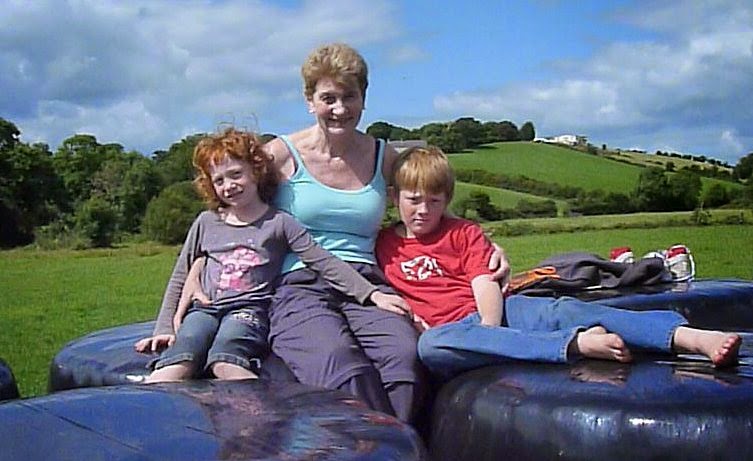
Before I went to Malawi, my daughter Judith came over from there with my 2 grand children, Daniel and Annika, to visit Northern Ireland and we went down to my ‘old caravan’ overnight.  The children had no TV, computer, internet games, Iphone or Ipads however had hours of fun playing on bales of hay.  These are a few of the very happy times we all had together on this lovely sunny day.


Annika


 Daniel


Judith


We walked up the Drumlins to our picnic area in the hay barn and passed these calves on the way.


 Annika has a very keen eye for nature and here she found a ladybird.


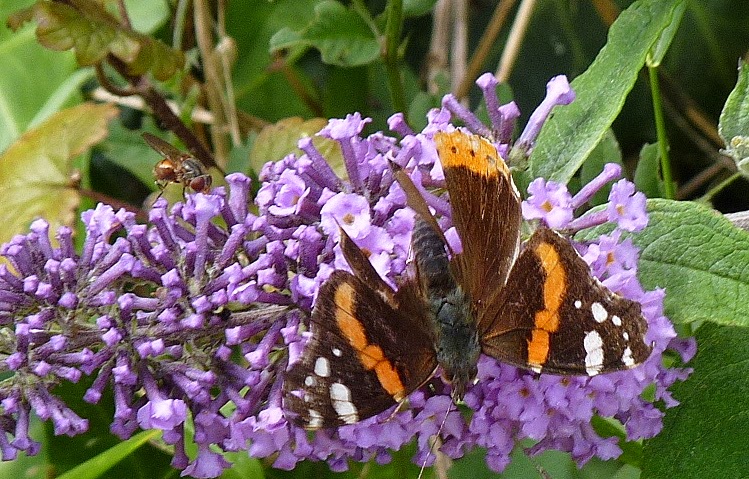
A well worn Admiral butterfly


More climbing and more great fun.  Just had time to stop for our picnic!


At the end of a wonderful day, we had a delightful sunset to view.


I took some video which can be access at

http://youtu.be/w7UYLkHAw24

If there is a black space, click it and the video will appear.


Thank you for visiting and for indulging me this post as it is quite personal but I wanted it recorded as a memory for me.

Many thanks for all your comments.

Tuesday, 23 September 2014

WILD BIRD WEDNESDAY - Pacific Baza

This is a bird that I was fortunate to see in my daughter’s garden when they were living near Innisfail, Queensland in Australia.  I know the shots are not great however I was delighted to see it although it was always positioned very high in the tree tops.


Pacific Baza - Aviceda subcristata -35–45 cm

Its habitats include margins and spaces of gallery forest, monsoon forest, swamp forest, rainforest and woodland, and tropical and subtropical open forests, preferably adjoining closed forest areas and often near water; occasionally uses suburban gardens in leafy tropical suburbs. 

Weaves and circles around the treetops, often in family parties, occasionally in flocks of 30 or more; plunges into canopy foliage, snatching at stick insects, mantids, frogs or small reptiles on branches or foliage or, at times, the ground. Gliding and soaring flight is graceful; effortlessly floats on long, wide wings.


Has spectacular aerial display flights: plunges down with wings held in steep dihedral showing underwing colour; then swoops up in a climb. Usually repeats the sequence several times, all the while calling loudly. Has a distinctive, rising and falling ‘whiech-yoo, whiech-yoo, whiech-yoo’; the first part scratchy yet musical, rising strongly; the final ‘yoo’ low and mellow; repeated many times in succession, the calls a few seconds apart. Also has a rather mellow and musical ‘kaka-kaka-kak-a kak-ak-ak’, at times by both birds together, very rapid. 


Breeds Oct.–Feb. in a forest or woodland tree; prefers valleys with streams, or near pools or billabongs. Nest is usually concealed in dense outer foliage, large clump of regrowth or mistletoe in a horizontal fork towards the limb’s outer extremity, 10–30 m up. The shallow, rather small bowl of sticks is well lined with green leaves. Clutch 3–4 (43 x 35 mm). Incubation by female; male brings food, briefly relieving her. Young hatch at 30–32 days; first down white; they stay in the nest for about 34 days.


Uncommon across North and NE Australia, rare in New South Wales.  I am home now and now, after 6 weeks away have quite a bit of caching up to do and I hope soon to catch up on your posts on your blogs.  I hope by next week, I will start my posts about my adventures in Africa although there is so many photographs and a lot of video clicks that will take weeks/ months to process but I will get there eventually.

I am linking this post with WILD BIRD WEDNESDAY

I hope you enjoyed this bird as much as I did when I saw it.  

I have now safely arrived back home from 6 weeks away so have LOTS of editing to do!!  Thanks to all of you who looked in on my posts while I was away and commenting especially as I either did not have internet or time.  I appreciate that very much.

Monday, 22 September 2014

Seals at Copeland Island

When I visit the Copeland Island, I always see Seals, usually both Common and Grey seals. These are photographs I took in June and I will give you some information about them so that you can distinguish one species from the other.


Common or Harbour seals are brown, tan, or gray, with distinctive V-shaped nostrils and has more of a pug nose. An adult can attain a length of 6.1 ft and a mass of 290 lb. Blubber under the seal's skin helps to maintain body temperature. Females outlive males (30–35 years versus 20–25 years).


Common seals stick to familiar resting spots or haulout sites, generally rocky areas (although ice, sand and mud may also be used) where they are protected from adverse weather conditions and predation, near a foraging area.


Males may fight over mates underwater and on land. Females bear a single pup after a nine month gestation, which they care for alone.


Pups can weigh up to 35 lb and are able to swim and dive within hours of birth. They develop quickly on their mothers' fat-rich milk and are weaned after four to six weeks.


On the other hand, the grey seal (Halichoerus grypus, meaning "hooked-nosed sea pig") is found on both shores of the North Atlantic Ocean. It is a large seal of the family Phocidae or "true seals". It is the only species classified in the genus Halichoerus. Its name is spelled gray seal in the US; it is also known as Atlantic grey seal and the Horsehead seal.


 It is a large seal, with bulls reaching 8.2–10.8 ft long and weighing 370–680 lb; the cows are much smaller, typically 5.2–6.6 ft long and 220–420 lb in weight. Individuals from the western Atlantic are often much larger, males reaching 880 lb and females weighing up to 550 lb.


I hope now you can distinguished the Grey from the Common seal by its straight head profile, nostrils set well apart, and fewer spots on its body.  Bull Greys have larger noses and a less curved profile than Common seal bulls. Males are generally darker than females, with lighter patches and often scarring around the neck. Females are silver grey to brown with dark patches.

This Grey Seal is sharing these rocks with a Lesser Black backed Gull.

I am still on my journey home and am now on the last leg and have  a little bit of free internet at Heathrow Airport, hence I am able to put on this post which I had in draft.

Thanks you for visiting.

Many thanks for comments you left on any of my posts.