Thursday, 7 November 2013

Sunset Over Distant Mourne Mountains

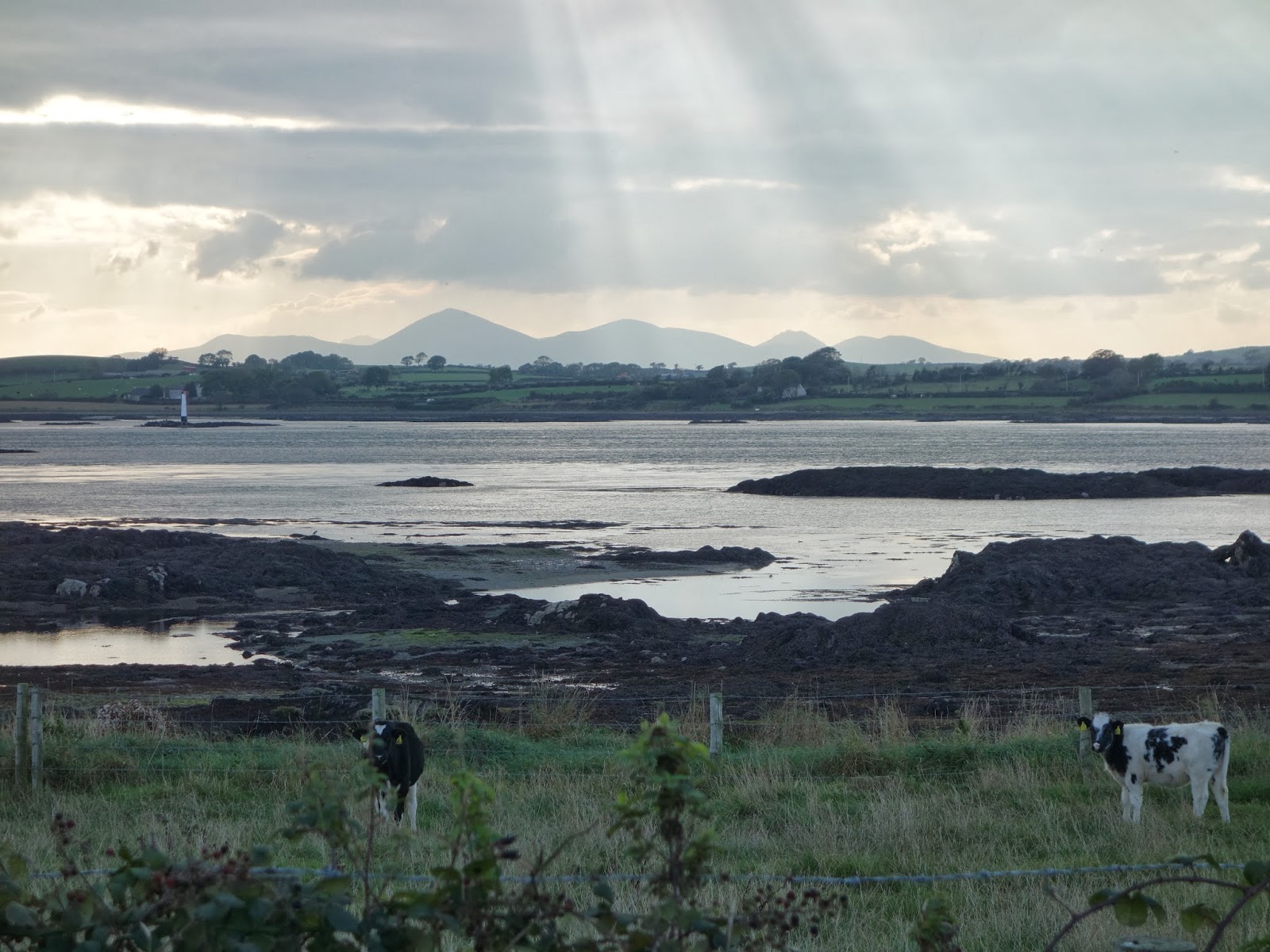
After Eileen and I visited Kearney and Ballyquintin Farm we headed homeward and when it was nearly dark we saw the Mountains of Mourne in the distance with a wonderful light coming down to the sea and both of us took some shots.  The first 6 shots are Eileen's and the following 5 are mine. 
 
So, once again, it is time for a cuppa, sit comfortably, and enjoy.


I hope you are enjoyed these shots. 
 
Tomorrow, Eileen and I go travel to to where the song says,
 
 "The Mountains of Mourne swept down to the sea". 
 
So look in to my post tomorrow and see what we discovered.
 
Have a great day/evening.
 
Thank you for visiting.

Wednesday, 6 November 2013

Metallic Starling

This is Wednesday again and time to tell you about an Australian bird.
 
The Metallic Starling Aplonis metallica also known as Shining Starling, is a bird in the starling family.  It is native of New Guinea and nearby Australasian islands and a limited area of north eastern Australia.  All these photos and video were taken around the Innisfail area, Queensland.
 
 
The introduced (feral) Common Starling has given starlings a bad name  in many parts of the world including Australia, South Africa and North America.  However,here is an exotic tropical one to infuse a bit of balance.  
 

They are 22–24 cm, with strikingly iridescent green and violet plumage, a piercing red eye, a long pointed tail and dashing flight, there’s nothing merely feral about this starling.


Like the Common Starling, however, they are highly social both in and out of the breeding season. They build large globular nests suspended in dense colonies in large rain forest trees.
 

In Australia, the Metallic Starling has a limited range along the north east coast of Queensland from the tip of Cape York to Mackay, but common only north of Ingham.  In Australia it is mainly a summer migrant from islands north of Australia, arriving in August/September and most have left by April, though some overwinter.

 
Their habitat is tropical rain forest, nearby woodland, mangroves, coastal scrub, gardens. Best known for the large and conspicuous treetop nest colonies, from which the flocks forage out across surrounding rain forest, seeking fruits and nectar.


 Tight flocks hurtle low above the canopy, attracting attention with their noisy passage – various nasal and wheezing calls. From individuals, ‘scriaarch, scraark, scraich-scraich-scraaairch, chrak-chrak-chrak’ and similar sounds; from the flock a jumbled racket of intermixed squawking and wheezing which you will hear on the video.


Many fledged juveniles are often present in these colonies and these are strikingly different in appearance from the adults with their white underparts with bold streaks, and could easily be mistaken for a different species.


 You can access the video at
 
 
If there is a black space below, click it and the video will appear.


I hope you enjoyed this Metallic Starling I featured on today's post.
 
Thank you for visiting and thanks for all your comments.  I appreciate them all.
Tuesday, 5 November 2013

Kearney and Ballyquintin Farm Discovered.

Eileen and I continued further down the coast ending at The National Trust property at Kearney village which has been restored to gave the authenticity of a traditional fishing village.  It looks across to Scotland, the Isle of Man and the Mourne Mountains.  The Trust owns the cottages and these have been restored in the vernacular style giving authenticity to this place of character. 

I am going to tell you a bit about the history of this beautiful village, then at the end of the post I have a short video of Linnets that I shot at Ballyquintin Farm.


I took this photograph from inside the information centre.


These are the cottages that you first see when you arrive.  All the cottages are rented, some are permanent homes however most are used as a second home and an escape from the stress, noise and trapping of ever day life.


I hope you can read the history from these photographs.


Now below is a story about a remarkable woman, Mary Ann Doonan.


This is Mary's fishing boat above.


As we passed some of the cottages, they had ornaments relating to the sea in their windows.


This seems to be the smallest of the cottages  however I think the people live in it all the year round.


Please note the 4 colours used here.  The black barrel, the red seat, the green door and the blue window sill.  The cottages itself was always white.  This is very typical of how these cottages were painted in Ireland years ago.


At the end of this path you see the sea but there is a path to the right and left covering several miles into other villages.  On the coast you kind Gannets, Redshank, Turnstone, Oystercatcher, Rock and  Meadow Pipit and we saw some of these. (we took the path to the left)


We left Kearney and headed for Ballyquintin Farm where there is a coastal path which passes through farmland, rocky shore and beach and this area is managed by the National Trust but there is also the National Nature Reserve owned and managed by the Environment & Hertiage Service.  We did not have time to explore all these area. (Eileen will just have to come back!)  

 Although we found a few birds at Ballyquintin Farm, we were fascinating to watch the 500 Linnets flying around and I made a short video clip of them.

It can be access at


If there is a black space below, click it and the video will appear.


I know that there was quite a bit of history in this post so I hope I have not bored you.  We enjoyed learning more about this village and seeing the Linnets flying up and down together.

Many thanks for visiting.

I am linking this post with Wild Bird Wednesday

Monday, 4 November 2013

Birding at Ballyhalbert Lakes

It was Day 5 of Eileen's visit and my class joined us for a morning's birding.  Jimmy, one of our members wanted to take us to a group of small lakes at Ballyhalbert.  So we left Bangor, stopping at various places along the County Down coast.  The first port of call was Groomsport village where we saw Oystercatchers,Turnstones, Shags and Redshank on the rocks, Cormorants flying by, 1 Common Guillemot diving for food and Gannets quite a distance out at sea.  It was a special day for Jimmy which I wil tell you about in a minute.
 
 
Redshank
 
 
Jetty at Groomsport harbour.  Do you see the Redshank?
 
 
A Buzzard flew overhead.
 
 
There are always Gulls sitting around the harbour.  This is a Herring Gull.
 
 
This is one of her young.
 
 
This is another of her young still begging for food.  She paid no attention to it!


Black headed Gull


We went further on down to Donaghadee where we stopped for coffee.  It was Jimmy's 80th birthday and I had got 8 cup cakes with candles which I tried to light about 80 times in the wind (I did it in the end) but it was a great surprise for him.  He is a real gentleman and has taught me many things about birds.


As you can see, Donaghadee lighthouse is in the backgound at the end of the Pier.  I am trying to light the candles in the back of the car!
 
 
Jimmy
 
 
We reached the small  lakes and found these 2 young Swans.  The water was quite brown and someone has dumped a waste bin in the water!
 
 
We wished we had had some food for them but we had eaten everything when we celebrated Jimmy's birthday at the last stop.


This cygnet had something buldging in its neck so we hoped it would be OK.


These were Crab Apples but I thought they looked lovely against the blue sky.  There were about 5 small lakes and other than Moorhen, Mallard and Little Grebe, there was nothing else on them, however it was extremely peaceful and I would think a good place to come to sit to watch butterflies and dragonflies in the summer.  There were quite a number of small birds.
 
 
This is a fun shot of us trying to take a photograph of this butterfly but yet not going to close to spook it.
 
 
This is the last Speckled Wood I have seen this year. (18 October)


 I hoped you enjoyed our morning's bird outing.  We left my class to travel on further and tomorrow I will tell you  where we went and what we saw.

Thank you for visiting. My computer seems to behavig at present but I am off on the train early this morning to walk along the whole of the towpath from Moira to Aghalee.  You may remember that Eileen and I walked along a bit of it when we were going to Portmore Lough.

Have a  lovely day and evening for those down under.