The other day I called into the RSPB Belfast Harbour Reserve,
unfortunately it decided to rain and as I can only photograph from inside anyway,
my photos were not as good as I had hoped.
However there was quite a lot to see and it is always lovely to see some of the young
birds out and about now.

Dunlin (above) are long-lived shorebirds that often mate with the
same partner over several seasons. In 126 recorded Dunlin breeding attempts,
biologists Lars-Åke Flodin and Donald Blomqvist found that 23% of the pairs
divorced. They compared the breeding success of males and females before and
after divorce to explore some causes and consequences of divorce. Divorcing
couples did not differ from non-divorcing couples in nest success in the season
preceding divorce, both in terms of total nest failure or the number of eggs in
the nest. Non-divorcing pairs and male
divorcees that paired with new partners had similar nest success in consecutive
years. However, female divorcees that found new partners doubled their nest
success. The authors concluded that female Dunlin divorce in order to upgrade
to a better mate or territory.
 |
| Shelduck Juvenile |

Shelduck and Black headed Gull losing the colour on his head.

One of the 4 cygnets breed at the Reserve

Lapwing Juvenile

The Common Sandpiper above is a rather small, short-legged wader
with a long, straight beak, relatively drab colouration, and a distinctive
‘teetering’ behaviour, in which the head and the rear of the body are
constantly bobbed up and down when the bird is standing or walking. The
head, upper breast and upper parts are greenish-brown with delicate dark
streaking, contrasting with the white underparts. A white eye-ring is visible
up close and the legs are greenish-grey. The common sandpiper has a distinctive
flight, with rapid, shallow wing beats on stiff, curved wings, and in flight a striking
white wing bar is visible.

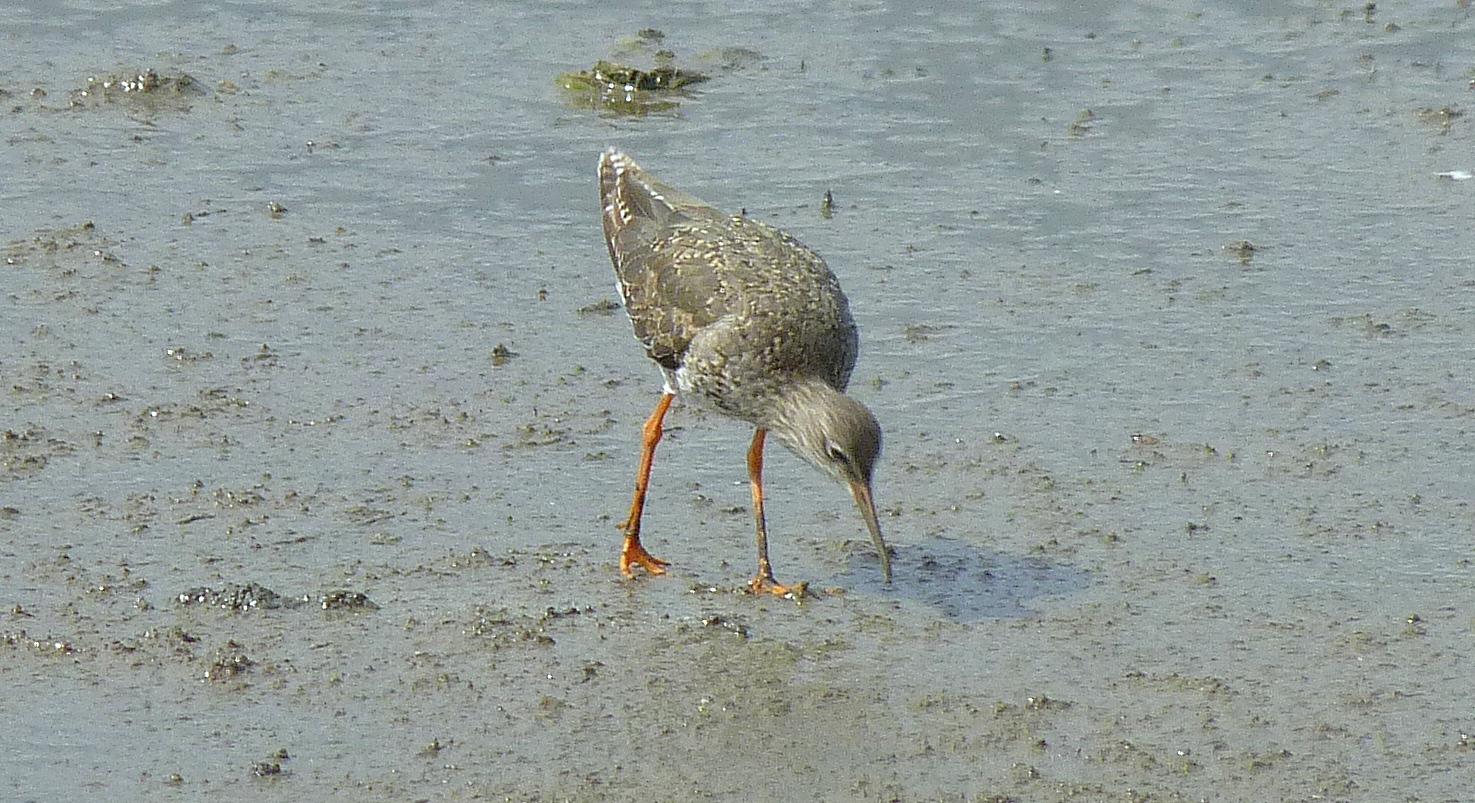
Redshank young

Then this Redshank decide to show me his ballad exercises!(below)


Black tailed Godwit
Although this species occurs in Ireland and Great Britain
all year round, they are not the same birds. The breeding birds depart in
autumn, and are replaced in winter by the larger Icelandic race, L. l.
islandica.

In 2006 the Black-tailed Godwit was classified as a Near
Threatened species by BirdLife International due to a decline in numbers of
around 25% in the previous 15 years.

They are monogamous and establish life-long relationships which can last up to 25 years, despite, or perhaps aided by the fact that the winters are spent around 600 miles apart.
A group of Godwits are collectively known as an "omniscience", "pantheon", and "prayer" of Godwits.

Then I spied this Black tailed Godwit (above) with tags on its legs
and after looking up the records discovered that this bird was first tagged on
15 July 2008 at E fra –Haganes, N of Langhus, Fijot, W. Siglufjovdeer, North
Iceland. It had also seen at the Belfast Reserve
on 30 June 09, 26 July 09, 13 July 11, 14 March and now 30 July. I was very excited that I had spotted this
bird. Below is a Black tailed Godwit in non breeding plumage.

Later at one of the other hides on the Reserve I saw Bar
tailed Godwits and 5 Ruff seen, 1 Wimbrel and Curlew among about 900 Black tailed Godwits.
Until recently, airliners could
not fly that distance without refuelling however these birds are not machines
but use their animal fat as fuel and that is from eating small
invertebrates. The flight is
calculated to be 175 hours which is 7.3 days.
You may well ask, So how do they do it?
They fed up before taking off on these flights, doubling their
weight. Some of their internal organs
shrink. You would expect that when they
arrive, they would be emaciated and have used up all their fat reserves. However, you would be wrong. Researches have caught some of these birds
and have found that they have enough fat left to fly another 3,000 miles. This is truly the bird with the longest
non-stop journey.
 |
| The rain stopped, the sun came out and the place looked totally different. |
Below is a young coot. It is a member of the Rallidae family of birds, which
includes Rails and Crakes, so, although it is often found in the company of
ducks, it does not have the webbed feet of a duck. However, it does have flaps
of skin on the toes that act in similar way to webs. The adult is about 15 inches and
are almost entirely slatey-black (the underparts being slightly lighter in tone)
apart from the white bill and front of the head. The white patch, which
extends to above the eye line, is what gives rise to the expression "bald
as a coot", although the coot is no more bald than is the "bald
eagle"! Males and females look very similar.

Coots are aggressive birds, both to other species and their
own kind; they have even been known to kill their own young, usually the
youngest of the brood if they have too many to feed successfully.
Coots are territorial and will swim menacingly towards any
intruders on their patch. They are closely related to moorhens and, though
found in the same highly vegetated lakes and ponds, the two species do not
compete for food. Coots dive below the surface, to depths of up to two metres,
searching insect larvae and other food. When they take off from the water, they
run along the surface. They are sociable birds, often seen feeding together in
flocks on pond.

Mother and her 2 chicks, later the Father turned up.

I thought I would show you the view we have from inside of the Reserve, the photo above is to the left and below is to the right. You can probably see in the background the the channel where all the ships come up and some of the cranes in Belfast harbour.


This is the mother Moorhen above with her chick below.

Below this photo (not good) are mainly Oystercatchers and Godwits and is on the far away bank, near where you see the shipping channel in the photos above.


This is a black head gull looking at itself and saying,
" Is that really me"!

"Boy, I am handsome"!
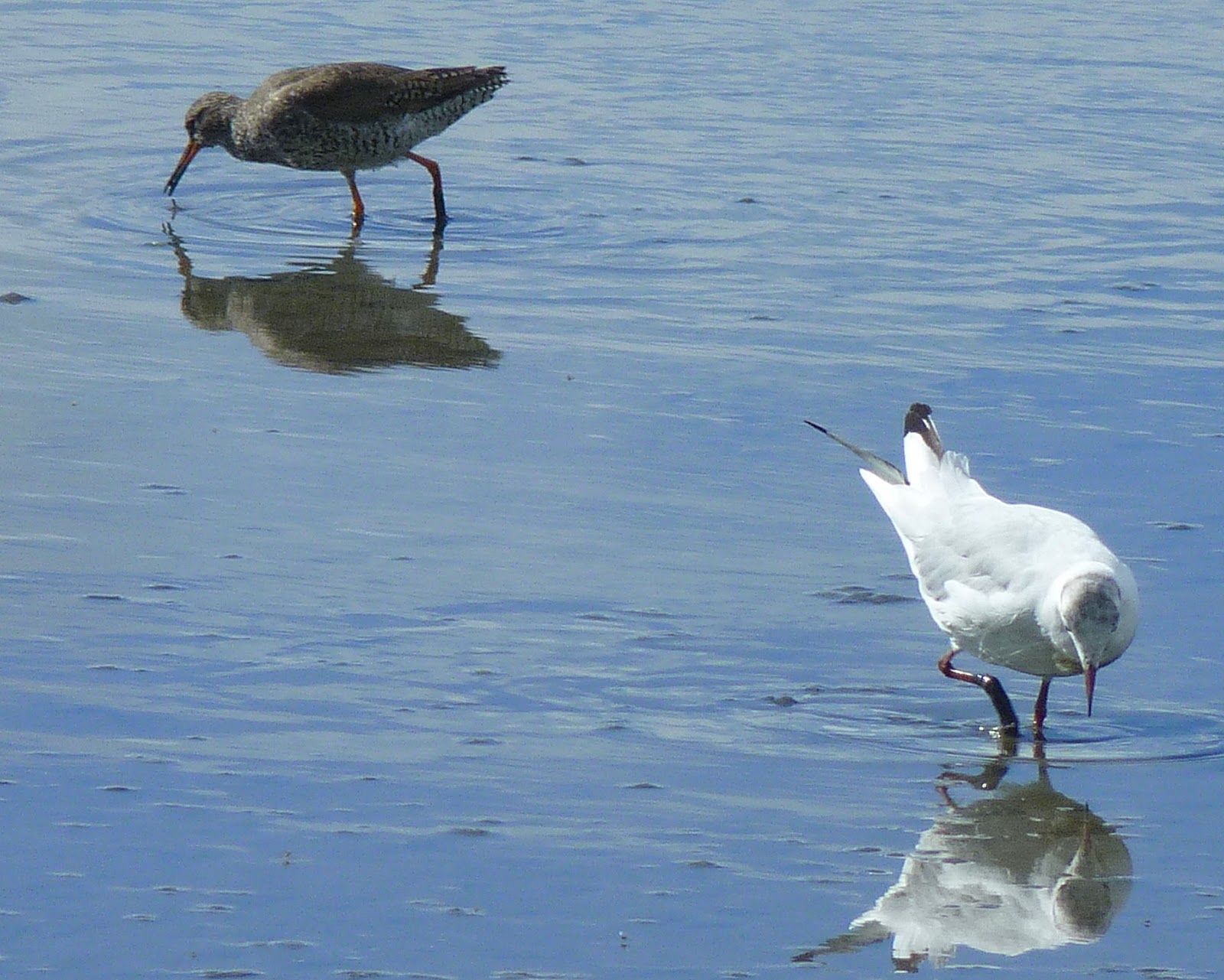
Young Redshank and Black headed Gull

There are 2 Tern islands and you may remember in a previous post, that I wondered if the returning Terns were going be able to breed because it was covered in Black headed Gulls, however as you can (just) see, both the Common and Arctic Terns managed to breed. We had 150 pairs of Common Gulls and 16 pairs of Arctic Terns.
Scientists have
tracked the pole-to-pole migration of 11 Arctic terns using a tiny device that records location and they discovered that the
small birds travelled an average of 44,000 miles a year, with one completing an
annual round-trip journey of 50,700 miles. The new findings show that the
Arctic tern migrates farther than any living thing and that, over the course of
the tern’s three-decade lifespan, the bird — weighing just 3.5 ounces — travels
1.5 million miles. That’s equivalent to three round-trips to the moon.
The
latest study, conducted by an international team of scientists used
“geolocators” attached to the birds’ legs. The devices, weighing just .05
ounces, recorded the birds’ location by measuring light intensity and day
length. The study, which nearly doubled the estimate of the terns’ migrations,
showed that after leaving Greenland and Iceland in the fall, the birds fed in
Arctic waters before flying south to the Antarctic Peninsula. They followed two
routes, along the coast of South America or Africa. The birds then spent the
southern summer in Antarctica before returning to the Arctic in April and May,
following an S-shaped path to take advantage of wind currents. On the way home,
the birds averaged 323 miles per day.
Surely the Arctic Tern earns the title of the bird having the longest migration.

Just to the right of the reserve is this bird feeder with Greenfinch and Goldfinch

With all this activity going on, this Wood Pigeon is just sitting quietly sunning himself.
I was excited to see 2 Little Gulls which we do not get here in Northern Ireland too often.
I will leave you with a video I took that day. There is quite a bit of background noise from other people at the Reserve and also a young lady who was standing beside me was asking me questions and she did not know I was taking a video then. It is great to be able to encourage young people who come into the Reserve. A young man called Adam was also there and he is very keen and a great photographer.
The video can be accessed at http://youtu.be/b_lE1Om5vpY If there is a black space below, click on it.
Thank you for joining me today as I vistied the RSBP Belfast Reserve and I hope you will look in again tomorrow as I have some more photos around the Reserve area.
MANY THANKS TO ALL who visited my blog yesterday and left comments.


